
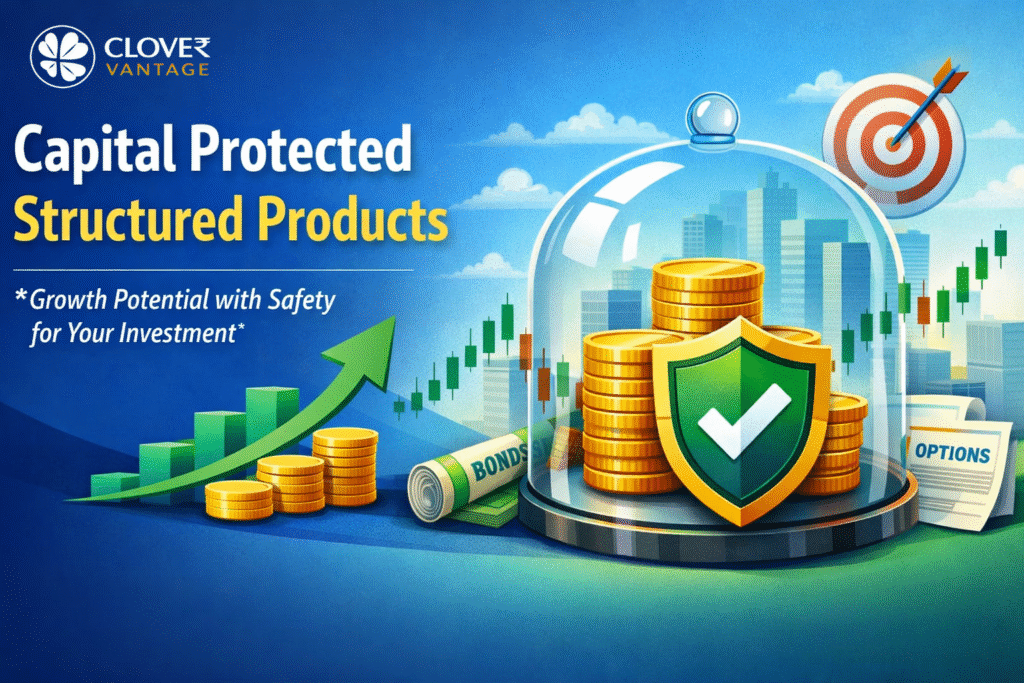
What if you could participate in market growth—without risking most of your capital?
That’s exactly what Capital Protected Structured Products (CPSPs) aim to offer.
In a world where market volatility keeps investors on edge, especially first-time or conservative investors, capital protection strategies are gaining serious attention. Whether you’re a high-net-worth individual (HNI) or a cautious investor stepping into equities, this investment approach offers a compelling middle ground.
Let’s break it down in a way that actually makes sense
Capital Protected Structured Product
A Capital Protected Structured Product is a hybrid investment solution designed to:
- Protect your initial investment (fully or partially)
- Provide exposure to market-linked returns
It combines fixed-income instruments (like bonds) with derivative strategies (like options) to create a structured payoff.
In simple terms:
A large portion of your money is invested safely, while a smaller portion is used to generate market-linked returns.
How structured products work?
Here’s a simplified breakdown of how CPSPs function:
1. Capital Protection Component
A major portion (typically 80–90%) of your investment goes into safe instruments like:
- Government bonds
- High-rated corporate bonds
These grow over time to ensure that your initial capital is preserved at maturity.
2. Growth Component
The remaining portion is invested in:
- Equity-linked derivatives
- Index options (like Nifty 50)
This part generates potential upside returns based on market performance.
Example to Understand Better
Let’s say you invest ₹10 lakhs in a capital protected product:
- ₹9 lakhs → Invested in bonds (safe, ensures capital protection)
- ₹1 lakh → Invested in equity derivatives (growth potential)
Outcomes:
- If the market performs well → You earn attractive returns
- If the market performs poorly → Your capital remains largely protected
Key Features of Capital Protected Products
1. Downside Protection
The biggest advantage is right in the name—capital protection.
While it may not always guarantee 100% safety (depending on the structure), it significantly reduces downside risk.
2. Market-Linked Returns
Unlike traditional fixed deposits, CPSPs offer:
- Higher return potential
- Equity market participation
3. Customizable Investment Structure
These products can be tailored based on:
- Risk appetite
- Investment horizon
- Return expectations
4. Defined Tenure
Most capital protected products come with a fixed tenure (usually 3–5 years), making them ideal for goal-based investing.
Who Should Invest in Capital Protected Structured Products?
This strategy isn’t for everyone—but it’s perfect for specific investor profiles.
Ideal for:
✅ Conservative investors entering equity markets
✅ HNIs looking for risk-adjusted returns
✅ Investors with lump sum capital
✅ Those who want predictability with growth potential
Not ideal for:
❌ Investors seeking high liquidity
❌ Short-term traders
❌ Those looking for guaranteed high returns
Benefits of Capital Protected Structured Products
1. Peace of Mind
Market volatility doesn’t feel as scary when your capital is largely protected.
2. Better Than Traditional Fixed Income
Compared to FDs or bonds:
- Potentially higher returns
- Market participation
3. Portfolio Diversification
CPSPs add a hybrid layer to your portfolio, balancing:
- Safety
- Growth
4. Tax Efficiency (in some structures)
Depending on how the product is structured, taxation may fall under capital gains rather than income tax—making it more efficient than traditional interest income.
Risks You Should Know
No investment is completely risk-free—even capital protected ones.
1. Credit Risk
If the bond issuer defaults, capital protection may be impacted.
2. Limited Upside
Returns are often capped. You won’t fully benefit from a strong bull market.
3. Liquidity Constraints
Most products are locked in for a fixed tenure, and early exit can be costly.
4. Complexity
These products are not always easy to understand. Transparency depends on the provider.
Capital Protected Products vs Mutual Funds vs PMS
| Feature | Capital Protected Products | Mutual Funds | PMS |
| Risk Level | Low to Moderate | Moderate to High | High |
| Capital Protection | Yes (partial/full) | No | No |
| Return Potential | Moderate | Moderate to High | High |
| Liquidity | Low | High | Medium |
| Customization | High | Low | High |
Are Capital Protected Products Safe?
They are relatively safer than direct equity investments, but not entirely risk-free.
Safety depends on:
- Quality of underlying bonds
- Structure of the product
- Market conditions
Key Tip: Always evaluate the issuer and read the product structure carefully before investing.
When Should You Consider Investing?
Capital protected products make the most sense when:
- Markets are volatile or uncertain
- You want to enter equities cautiously
- You have a lump sum investment
- You prioritize capital preservation over aggressive growth
Final Thoughts: Smart Investing is About Balance
Let’s be honest—everyone wants high returns.
But not everyone is comfortable with high risk.
That’s where Capital Protected Structured Products shine. They’re not about chasing maximum returns—they’re about smart, balanced investing.
They help you stay invested in the market without losing sleep over every dip.
Frequently Asked Questions (FAQs)
1. Is capital protection guaranteed?
Not always. It depends on the structure and issuer. Some products offer full protection, others partial.
2. What is the typical tenure?
Usually between 3 to 5 years.
3. Can I withdraw early?
Early exit is possible but may involve penalties or losses.
4. Are returns fixed?
No. Returns are market-linked, but the downside is limited.
5. Is it better than mutual funds?
Not necessarily. It depends on your risk appetite. CPSPs are safer, while mutual funds offer higher growth potential.
Call to Action
If you’re looking to grow your wealth without exposing your entire capital to market risk, capital protected structured products could be a smart addition to your portfolio.
At Clover Capital, we help you design investment strategies that balance growth, safety, and long-term financial goals.
👉 Want to explore if this fits your portfolio? Let’s talk.