
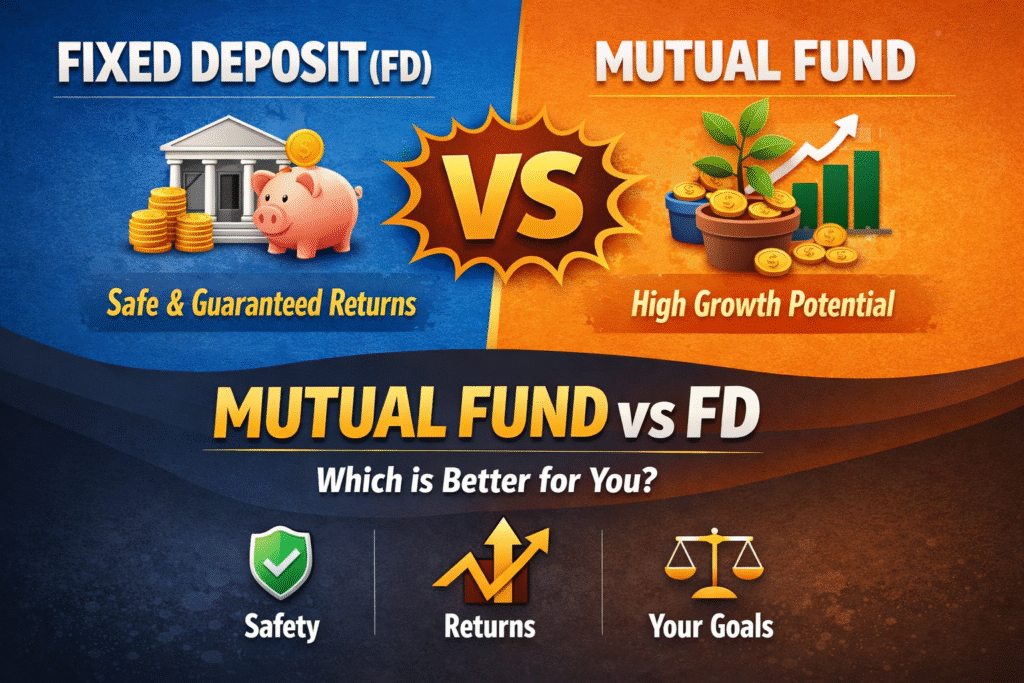
If you want higher returns and long-term wealth creation, mutual funds are generally better. If you prefer safety and guaranteed returns, fixed deposits (FDs) are the safer option. The right choice depends on your risk appetite and financial goals.
What is a Mutual Fund vs FD?
🔹 Mutual Fund
A mutual fund pools money from multiple investors and invests it in stocks, bonds, or other assets. Managed by professionals, it offers market-linked returns.
🔹 Fixed Deposit (FD)
A fixed deposit is a traditional investment where you deposit money in a bank for a fixed tenure at a predetermined interest rate.
Mutual Fund vs FD: Key Differences
| Feature | Mutual Fund | Fixed Deposit |
| Returns | Market-linked (higher potential) | Fixed & guaranteed |
| Risk | Moderate to high | Very low |
| Liquidity | High (except ELSS) | Moderate (penalty on early withdrawal) |
| Taxation | Capital gains tax | Fully taxable interest |
| Inflation Impact | Beats inflation (long-term) | Often fails to beat inflation |
Benefits of Mutual Funds (India)
When comparing Mutual Fund vs FD, mutual funds clearly stand out for growth.
✅ Higher Returns
Historically, equity mutual funds in India have delivered 10–15% returns, much higher than FD returns (5–7%).
✅ Power of Compounding
Through SIPs, your money grows consistently over time.
✅ Tax Efficiency
Long-term capital gains (LTCG) above ₹1 lakh are taxed at only 12.5%, making them more tax-efficient than FDs.
✅ Flexibility
You can start investing with as little as ₹500 via SIP.
Benefits of Fixed Deposits
FDs are still popular in India—and for good reason.
✅ Capital Protection
Your money is safe and unaffected by market fluctuations.
✅ Guaranteed Returns
You know exactly how much you’ll earn.
✅ Ideal for Short-Term Goals
Perfect for emergency funds or short-term savings.
How Mutual Funds Work
- You invest via SIP (Systematic Investment Plan) or lump sum
- Fund managers invest in stocks/bonds
- Returns depend on market performance
- NAV (Net Asset Value) reflects fund value
Example:
If you invest ₹5,000/month in a mutual fund for 10 years at 12% returns, your investment of ₹6 lakh can grow to ~₹11.6 lakh.
How FD Works
- You deposit a fixed amount in a bank
- Interest rate is fixed (e.g., 6.5%)
- At maturity, you receive principal + interest
- Tax added to investor income
Example:
₹5 lakh invested in an FD at 6.5% for 5 years becomes ~₹6.87 lakh.
FD vs Mutual Fund Returns in India
Let’s break it down clearly:
- FD: ~5–7% annual returns
- Mutual Funds (Equity): ~10–15% long-term
Over time, the difference becomes huge due to compounding.
Reality Check:
If inflation is 6% and your FD gives 6.5%, your real return is almost zero.
Common Mistakes to Avoid
Choosing FD Only for Safety
You may lose purchasing power due to inflation.
Expecting Quick Returns from Mutual Funds
Mutual funds require patience (minimum 3–5 years).
Ignoring Tax Impact
FD interest is taxed as per your income slab, which can reduce returns significantly.
Not Diversifying
Smart investors use both FD + mutual funds for balance.
Which is Better: Mutual Fund or FD?
Here’s the simple answer:
- Choose FD if:
- You want safety
- You need money in the short term
- You are risk-averse
- If you fall in lower tax battle
- Choose Mutual Funds if:
- You want wealth creation
- You can invest for the long term
- You can handle market fluctuations
Best Strategy: Use both.
FD for safety + Mutual Funds for growth.
FAQ Section
1. Is SIP better than lump sum?
Yes, SIP is better for most investors because it reduces market timing risk and builds discipline. Lump sum works best in falling markets or for experienced investors.
2. How much tax on mutual funds in India?
- Equity funds:
- LTCG (above ₹1 lakh): 10%
- STCG: 15%
- Debt funds: Taxed as per income slab (post-2023 rules)
3. Are mutual funds safe in India?
Mutual funds are regulated by SEBI, but they are market-linked. They are safe in terms of regulation but not risk-free like FDs.
4. Which gives higher returns: FD vs mutual fund?
Mutual funds generally give higher returns than FDs, especially over the long term.
5. Can I lose money in mutual funds?
Yes, in the short term. But over the long term, diversified equity mutual funds have historically generated positive returns.
Final Thoughts
The debate of Mutual Fund vs FD is not about which is better—it’s about what suits you.
If you play it too safe, you may never beat inflation.
If you take calculated risks, you can build real wealth.
The smartest investors don’t choose one. They balance both.