

By the Clover Capital Investment Research Team Last updated: June 2026 | 12-minute read Reviewed by: Clover Capital’s SEBI-registered investment advisors
Quick Summary: With over 2,500 mutual fund schemes available in India today, How to Choose the Right Mutual Fund can feel overwhelming. This guide walks you through exactly what mutual funds are, how to compare them, and which factors matter most — so you can invest with confidence.
Table of Contents
- What Is a Mutual Fund?
- Why Choosing the Right Mutual Fund Matters
- Types of Mutual Funds to Invest In
- How to Choose a Mutual Fund: A 5-Step Strategic Checklist
- How to Compare Mutual Funds Effectively
- Which Is the Best Mutual Fund to Invest In?
- Common Mistakes Beginners Make
- How Clover Capital Simplifies Your Investment Journey
- Frequently Asked Questions
What Is a Mutual Fund?
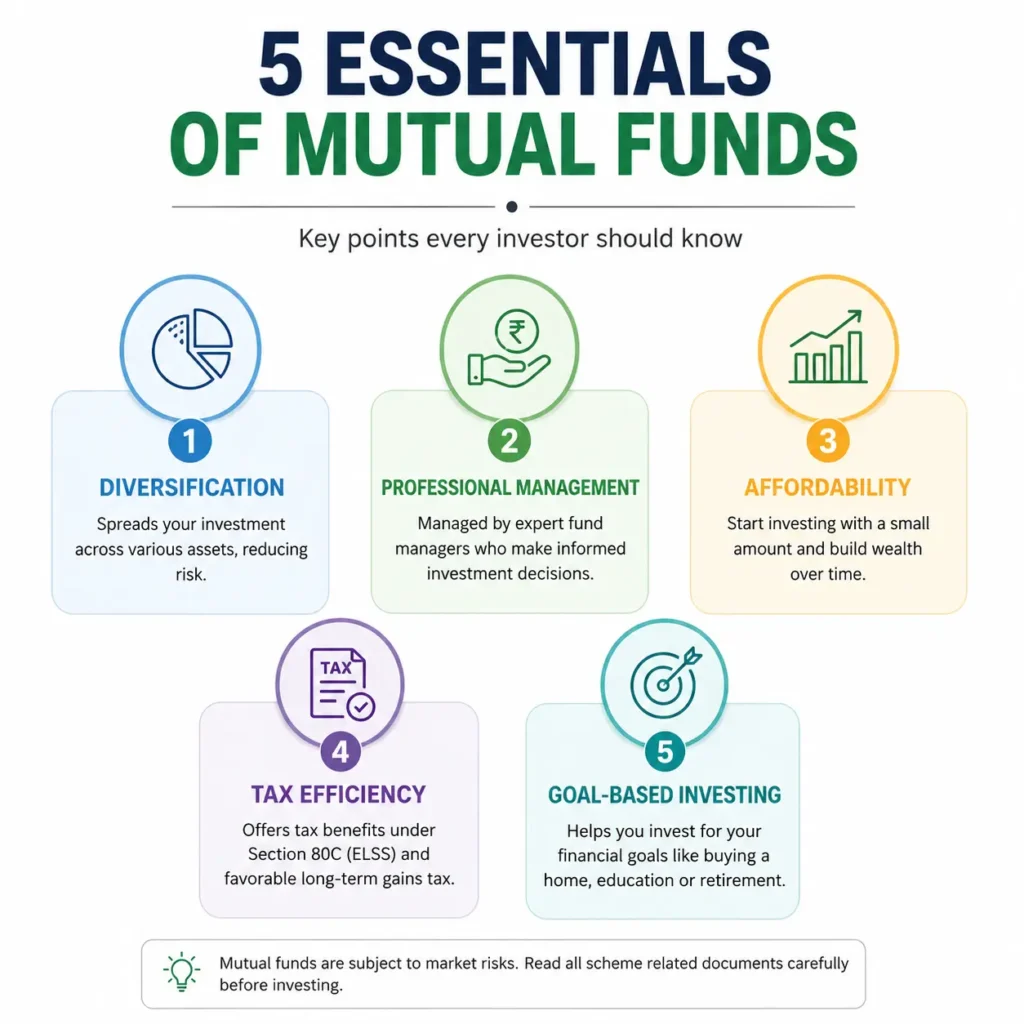
A mutual fund is a professionally managed investment vehicle that pools money from multiple investors and allocates it across a diversified basket of securities — such as stocks, bonds, or money market instruments — based on a defined investment objective.
When you invest in a mutual fund, you purchase units of the fund. The value of these units, known as the Net Asset Value (NAV), fluctuates based on the performance of the underlying securities in the fund’s portfolio.
Key characteristics of mutual funds:
- Managed by qualified fund managers registered with SEBI
- Regulated by the Securities and Exchange Board of India (SEBI)
- Available to resident Indians, NRIs (subject to FEMA regulations), and minors (through guardians)
- Accessible with investments starting as low as ₹100–₹500 per month via a SIP
Mutual funds have emerged as one of the most accessible and structured routes to wealth creation in India — offering liquidity, diversification, and professional management under a single roof.
How to Choose the Right Mutual Fund
Not all mutual funds are created equal. A fund that works brilliantly for a 28-year-old software engineer with a 20-year horizon and high risk appetite is likely the wrong fund entirely for a 55-year-old professional approaching retirement.
Selecting a fund without aligning it to your personal financial goals, risk tolerance, and investment timeline can result in:
- Underperformance relative to your financial goals
- Unnecessary volatility and anxiety during market downturns
- Liquidity mismatches when you need urgent access to capital
- Higher costs eating into your net returns over time
Getting this right is not about chasing the fund with the highest historical return. It is about finding the right fit — for you, right now, and for where you want to be financially.
Types of Mutual Funds to Invest In
Understanding the landscape of mutual fund categories is the foundation of building a smart portfolio. Here is a breakdown of the major fund types available in India:
1. Equity Mutual Funds
Equity funds primarily invest in shares of publicly listed companies. They generate returns through capital appreciation (rise in stock price) and dividends.
Ideal for: Investors with a long investment horizon (5+ years) and a moderate-to-high risk appetite.
Sub-categories:
| Fund Type | What It Invests In | Risk Level |
| Large-Cap Funds | Top 100 companies by market cap | Moderate |
| Mid-Cap Funds | Companies ranked 101–250 by market cap | Moderate–High |
| Small-Cap Funds | Companies ranked 251 and below | High |
| Multi-Cap Funds | Across all market capitalisation tiers | Moderate–High |
2. Debt Mutual Funds
Debt funds invest in fixed-income instruments such as government securities, corporate bonds, treasury bills, and money market instruments. They offer more stable, predictable returns with lower volatility.
Ideal for: Conservative investors seeking capital preservation, a regular income stream, or short-to-medium term goals.
3. Index Mutual Funds
Index funds passively replicate the performance of a market benchmark — such as the Nifty 50 or the BSE Sensex. They invest in the exact same securities in the same proportions as the underlying index.
Key advantage: Lower expense ratios compared to actively managed funds, making them a cost-efficient long-term option.
Limitation: They mirror the full index, meaning they cannot capitalise on specific opportunities or outperform the market during rallies.
4. Hybrid Mutual Funds
Hybrid funds invest across multiple asset classes — typically a combination of equity and debt — in varying proportions, depending on the fund’s objective.
Ideal for: Investors seeking a balance between capital growth and income stability, with a moderate risk appetite.
5. Solution-Oriented Funds
These funds are designed for specific life goals such as retirement planning or children’s education funds. They often come with lock-in periods to encourage goal-aligned, long-term investing.
How to Choose a Mutual Fund: A 5-Step Strategic Checklist
Step 1: Define Your Financial Goals
Your investment goals are the anchor for every decision that follows. Ask yourself:
- Short-term goals (under 3 years): Vacation, vehicle purchase, emergency fund top-up — debt funds or liquid funds are generally more appropriate here.
- Medium-term goals (3–5 years): Down payment on a home, higher education — consider hybrid or balanced funds.
- Long-term goals (5+ years): Retirement corpus, children’s education, wealth creation — equity funds or index funds are generally well-suited.
Clearly defining what you are investing for gives you a north star against which every fund can be evaluated.
Step 2: Know Your Risk Profile
Risk tolerance is deeply personal. It is determined not just by your financial capacity to absorb losses, but also by your emotional temperament during market volatility.
SEBI-registered advisors broadly classify investor risk profiles into five categories:
Risk-Averse Prioritises capital safety above all else. Comfortable earning returns in line with bank deposit rates, even if they do not beat inflation. Liquid funds and overnight funds are typically suitable.
Conservative Willing to accept a small degree of risk to earn slightly higher returns than deposit rates. Short-duration debt funds or conservative hybrid funds may align well.
Moderate Seeks a balance between capital growth and income stability. Balanced hybrid funds or large-cap equity funds with a medium-term horizon are often appropriate.
Moderately Aggressive Willing to accept higher volatility in exchange for meaningfully higher long-term returns. Multi-cap or flexi-cap equity funds may be worth considering.
Aggressive Focused on maximising long-term capital growth and comfortable with significant short-term drawdowns. Mid-cap, small-cap, or sector-specific funds may be explored — with a long horizon.
Pro Tip: Your risk profile should be reassessed periodically. Life events — a new job, a marriage, the birth of a child, or approaching retirement — all warrant a relook at your risk appetite.
Step 3: Evaluate Fund Performance Honestly
Past performance does not guarantee future returns — but it is still a meaningful signal. When reviewing fund performance, go beyond surface-level numbers:
- Compare against the benchmark: A fund that returned 14% in a year when its benchmark returned 16% has underperformed, even if 14% sounds attractive in isolation.
- Compare within the same category: Comparing a small-cap fund to a large-cap fund is not a fair comparison. Always benchmark like-for-like.
- Look at rolling returns over 3, 5, and 10 years: One-year returns can be misleading. Consistent performance across full market cycles is a more reliable indicator of fund quality.
- Assess downside protection: How did the fund perform during market corrections (e.g., 2020, 2022)? A fund that holds its ground better during downturns often reflects stronger risk management.
Step 4: Understand All Costs Involved
Costs compound just as returns do. Two funds that appear similar can yield meaningfully different outcomes over 10–15 years simply because of cost differences.
Expense Ratio This is the annual fee charged by the fund house to manage your investment, expressed as a percentage of your average AUM. Lower is generally better — especially for passively managed index funds, where high expense ratios erode a significant portion of returns over time.
Exit Load Some funds charge a fee if you redeem your investment before a specified holding period (typically 1 year for equity funds). If you anticipate needing to access your money earlier than the lock-in, factor this cost into your decision.
Taxes (LTCG / STCG) Equity fund gains held over 1 year are subject to Long-Term Capital Gains (LTCG) tax at 12.5% (above ₹1.25 lakh per year). Short-term gains are taxed at 20%. Debt fund gains are taxed as per your applicable income tax slab, regardless of holding period.
Step 5: Assess Liquidity Requirements
Liquidity — how easily you can convert your investment to cash — is a critical but frequently overlooked dimension of mutual fund selection.
Consider:
- Emergency access: If you may need the money quickly (within days), opt for liquid or overnight funds with no exit loads.
- Lock-in periods: ELSS funds (for tax savings under Section 80C) carry a mandatory 3-year lock-in. Ensure this aligns with your plans before investing.
- Fund size: Very small funds can sometimes face liquidity constraints during large redemption events. Larger, well-established funds tend to be more liquid.
How to Compare Mutual Funds Effectively
When you are ready to shortlist specific funds, here is a practical framework for comparing mutual funds:
| Parameter | What to Look For |
| 5-Year Rolling Returns | Consistency, not just peaks |
| Expense Ratio | Lower is better, especially for index funds |
| Sharpe Ratio | Higher means better risk-adjusted returns |
| Standard Deviation | Lower means less volatility |
| Fund Manager Tenure | Longer tenure provides more data on their strategy |
| AUM (Assets Under Management) | Sufficient size indicates market confidence |
| Exit Load & Lock-In | Assess against your liquidity needs |
Use platforms like Clover Capital to compare funds across these dimensions side-by-side, without having to manually pull data from multiple sources.
Which Is the Best Mutual Fund to Invest In?
Here is an honest answer: there is no single “best” mutual fund.
The best mutual fund to invest in is always context-dependent — defined by your goals, your risk tolerance, your investment horizon, and your financial situation.
That said, certain categories tend to suit common investor archetypes:
- First-time investors: Large-cap equity funds or index funds — lower volatility, transparent holdings, lower costs
- Long-term wealth builders: Flexi-cap or multi-cap equity funds — broad market exposure with professional allocation
- Capital-preservation seekers: Short-duration debt funds or conservative hybrid funds
- Tax savers: ELSS funds — eligible for deductions up to ₹1.5 lakh under Section 80C
- Market-mirroring investors: Nifty 50 or Sensex index funds — low cost, passive, benchmark-aligned
The most resilient portfolios are not built around a single “best” fund — they are built around a diversified mix of fund types that work in concert.
The Case for Diversification
Concentrating your investments in a single fund or a single fund category exposes your portfolio to concentrated risk. A well-diversified mutual fund portfolio ensures that underperformance in one segment can be offset by gains in another.
Diversification also allows you to:
- Tap into different fund management styles and strategies
- Balance short-term stability with long-term growth
- Manage risk more effectively across different market cycles
Think of it as building a team, not betting on a single player.
Common Mistakes Beginners Make When Choosing Mutual Funds
Avoid these pitfalls that trip up many first-time investors:
1. Chasing last year’s top performer A fund that topped the charts last year is not guaranteed to do so next year. Performance consistency across market cycles matters more than a single standout year.
2. Ignoring costs A 0.5% difference in expense ratio may seem negligible, but compounded over 20 years, it can translate to a significant difference in your final corpus.
3. Treating SIP as a “set and forget” exercise SIPs are powerful — but your fund selection should be reviewed annually to ensure it still aligns with your goals and market conditions.
4. Investing without a goal Without a clear financial goal, you have no basis to assess whether your fund is performing adequately — or even what “adequate” means for your situation.
5. Panicking and redeeming during market downturns Equity markets are inherently volatile. Premature redemptions during corrections often lock in losses and cause investors to miss the subsequent recovery.
How Clover Capital Simplifies Your Investment Journey
Choosing the right mutual fund is the first step. Staying on top of it — through market cycles, life changes, and evolving goals — is equally critical.
Clover Capital is built to make this entire journey effortless for you:
- Access over 300 mutual funds across 23+ fund houses, mapped to different risk profiles
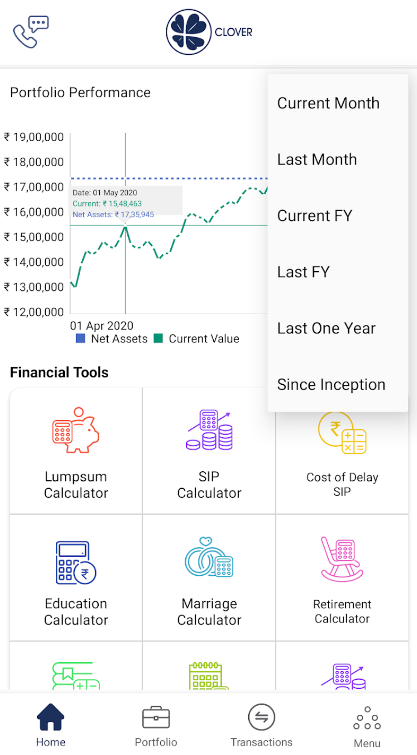
- Monitor all your holdings and their performance from a single, unified dashboard
- Stay informed with expert market outlook reports and sector analyses
- Plan your investments using SIP calculators and goal-planning tools
- Invest and manage your portfolio anytime, anywhere
Whether you are just beginning your investment journey or looking to optimise an existing portfolio, Clover Capital gives you the tools to invest on your own terms — with clarity and confidence.
Frequently Asked Questions
Q1. What is a mutual fund in simple terms? A mutual fund pools money from many investors and invests it in a diversified basket of securities — stocks, bonds, or both — managed by a professional fund manager. You own units of the fund, and your returns depend on how the underlying investments perform.
Q2. Who can invest in mutual funds in India? Any resident Indian with a valid PAN card, an Indian bank account, and a completed KYC (Know Your Customer) verification can invest. NRIs are also eligible, subject to FEMA regulations.
Q3. What is the minimum amount needed to start investing in mutual funds? You can begin with as little as ₹100–₹500 per month through a Systematic Investment Plan (SIP), depending on the fund’s minimum requirements. Lump sum investments typically start at ₹1,000 or more.
Q4. How do I compare mutual funds before investing? Compare funds across key parameters: 3-to-5-year rolling returns, benchmark-relative performance, expense ratio, Sharpe ratio, standard deviation, and fund manager tenure. Always compare funds within the same category for a fair assessment.
Q5. Is it better to invest in one mutual fund or multiple? Diversifying across multiple fund types — for example, a mix of equity, debt, and index funds — generally results in a more resilient portfolio. A single fund concentrates your risk and limits your exposure to different growth opportunities.
Q6. Are mutual fund returns guaranteed? No. Mutual fund investments are subject to market risks. While debt funds tend to be more stable, no fund offers guaranteed returns. Always read the scheme information document before investing.
Q7. How often should I review my mutual fund portfolio? At a minimum, review your portfolio annually. Additionally, reassess whenever you experience a significant life event — a job change, marriage, the birth of a child, or approaching a major financial goal.
The information in this article is for educational purposes only and should not be construed as personalised investment advice. Mutual fund investments are subject to market risks. Please read all scheme-related documents carefully before investing. Past performance is not indicative of future results.
For personalized investment guidance, connect with a Clover Capital advisor today.
Clover Capital is a SEBI-regulated investment platform offering investors across India access to 300+ mutual fund schemes from 23+ leading fund houses. Our mission is to make investing simple, transparent, and accessible for every Indian investor.