
By Prasenjit Gupta, Founder, Clover Capital | Wealth Management & Financial Services, Kolkata.
AMFI-registered Mutual Fund Distributor | 55+ man-years of combined advisory experience | Last Updated: June 2026
Quick Summary
- Exit load is a fee deducted when you redeem mutual fund units before a minimum holding period
- It is charged on redemption value, not your original investment amount
- SEBI capped the maximum permissible exit load at 3% (reduced from 5% in September 2025)
- Most equity funds charge ~1% if redeemed within 12 months; overnight and many liquid funds charge zero
- In SIPs, each instalment is treated as a separate investment with its own exit load clock
- Exit load is not a tax — it stays within the scheme for the benefit of remaining investors
1. What Is Exit Load in Mutual Fund?
Exit load in a mutual fund is a fee that a fund house deducts from your redemption proceeds when you sell or redeem your units before a minimum holding period specified in the scheme’s offer document.
The term itself is self-explanatory: it is a “load” (charge) applied at the time of “exit” (redemption). It is expressed as a percentage of the redemption value — not your original purchase amount — and is deducted automatically before the money reaches your bank account.
Exit load exists for a straightforward reason: mutual funds — especially equity funds — are designed for medium-to-long-term investing. Frequent short-term redemptions force the fund manager to keep higher cash reserves or sell holdings at inconvenient times, which raises transaction costs for all remaining investors. The exit load places that cost on the investor who exits early, rather than distributing it across everyone in the scheme.
Key point: Entry load was abolished by SEBI in August 2009. Exit load is the only redemption-related charge that currently applies to mutual fund investors in India.
2. How Does Exit Load Work?
Here is a step-by-step breakdown of how exit load of mutual funds works in practice:
Step 1 — Investment: You invest in a mutual fund scheme. The Scheme Information Document (SID) specifies the exit load percentage and the holding period during which it applies.
Step 2 — Redemption request: You submit a redemption request, either fully or partially.
Step 3 — Calculation by the fund house: The fund house checks how long each unit has been held. If it falls within the exit load window, the applicable percentage is deducted from the redemption value.
Step 4 — Net payout: The remaining amount — after exit load deduction — is credited to your registered bank account, typically within T+2 or T+3 working days depending on the fund category.
A few additional mechanics worth knowing:
- Tiered structures are common. Some funds reduce the exit load percentage over time. For example, 1% for redemption within 6 months, and 0.5% for redemption between 6 and 12 months, and nil thereafter.
- The load clock restarts on switches. If you switch from one scheme to another within the same AMC, the new scheme’s exit load period starts fresh from the switch date.
- Exit load is credited back to the scheme, not to the fund house or SEBI. This means remaining investors in the scheme indirectly benefit from it.
- No exit load after the specified period. Once you cross the holding period mentioned in the SID, redemptions are fully free of exit load.
3. What Is Exit Load in Mutual Fund with Example
The best way to understand the meaning of exit load in mutual funds is through a practical example. Here are two contrasting scenarios using the same investment.
Scenario A — Redemption Before the Exit Load Period (1% Load Applies)
| Detail | Value |
| Investment date | 1 January 2025 |
| Investment amount | ₹1,00,000 |
| Fund’s exit load rule | 1% if redeemed within 12 months |
| Redemption date | 30 June 2025 (6 months — within 12 months) |
| Redemption value at NAV | ₹1,05,000 (assuming growth) |
| Exit load (1% of ₹1,05,000) | ₹1,050 |
| Net amount credited to you | ₹1,03,950 |
You effectively gave up ₹1,050 for redeeming early.
Scenario B — Redemption After the Exit Load Period (No Load)
| Detail | Value |
| Redemption date | 2 January 2026 (just over 12 months) |
| Redemption value at NAV | ₹1,18,000 (assuming further growth) |
| Exit load | ₹0 (holding period exceeded) |
| Net amount credited to you | ₹1,18,000 |
Waiting just a few extra days — past the 12-month mark — means zero deduction.
Practical takeaway: Before redeeming, always check your investment date against the fund’s exit load window. Even a difference of a few days can save a meaningful amount on larger portfolios.
4. What Is Exit Load Charges in Mutual Fund — Category-Wise
There is no single exit load that applies to all mutual funds. Each scheme sets its own, which must be disclosed in the SID. The table below reflects common industry practice as of 2026 — always verify the specific fund’s SID before acting.
| Fund Category | Typical Exit Load Structure |
| Equity Funds (Large/Mid/Small Cap, Flexi Cap) | ~1% if redeemed within 12 months; nil after |
| ELSS (Tax-Saving) Funds | No exit load — mandatory 3-year lock-in applies instead |
| Hybrid Funds (Aggressive/Balanced) | 0.5%–1% within specified period (often 12 months) |
| Arbitrage Funds | ~0.25% if redeemed within 30 days |
| Debt Funds (Medium/Long Duration) | Varies — often 0%–0.5% for short periods |
| Liquid Funds | Very short-duration load (some have nil after Day 7) |
| Overnight Funds | Typically nil |
| Ultra Short Duration Funds | Usually nil or negligible |
| Index Funds / ETFs | Low or nil — some apply 0.25% only within 3 days |
| Life Cycle / Target Date Funds (new 2026) | 3% (Year 1), 2% (Year 2), 1% (Year 3) — then nil |
Important: SEBI reduced the maximum permissible exit load cap from 5% to 3% following its board decision in September 2025. In practice, most equity funds already charge 1%–2%, but the regulatory ceiling is now formally lowered.
5. Mutual Fund Exit Load Calculator
Knowing the formula helps, but calculating exit load quickly and accurately before every redemption — especially across multiple investments with different entry dates — is where a mutual fund exit load calculator saves time.
Formula:
Exit Load Amount = Redemption Value × (Exit Load % ÷ 100)
Net Redemption Proceeds = Redemption Value − Exit Load Amount
Quick calculation example:
| Input | Value |
| Redemption value | ₹5,00,000 |
| Applicable exit load | 1% |
| Exit load deducted | ₹5,000 |
| You receive | ₹4,95,000 |
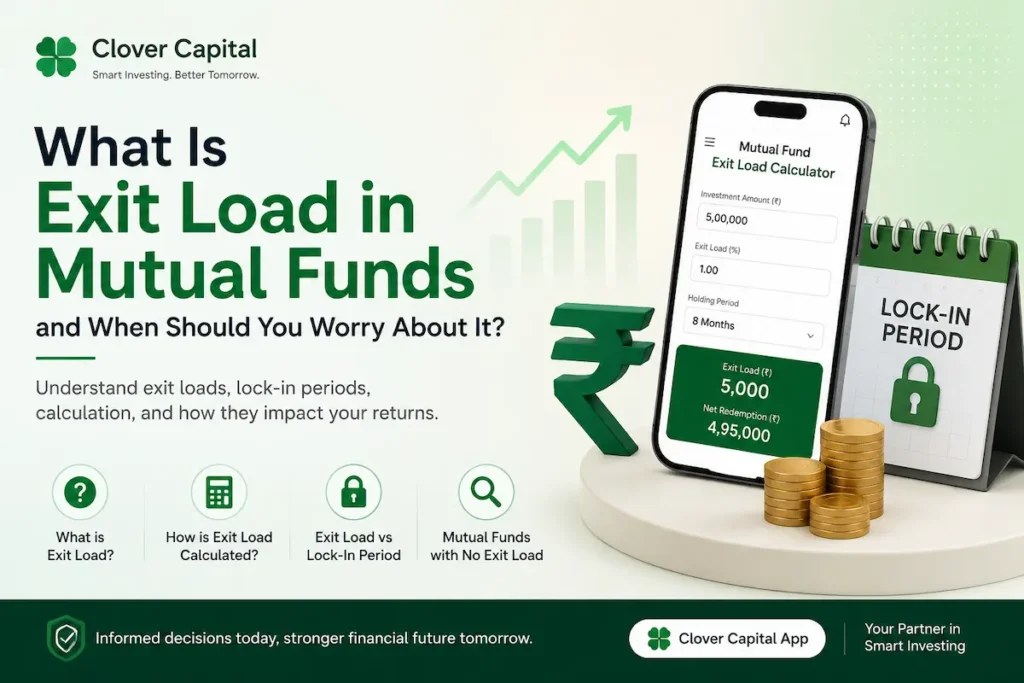
The Clover Capital App includes a Mutual Fund Exit Load Calculator that lets you input your investment amount, entry date, and fund-specific exit load terms to see the net redemption amount instantly. This is especially useful when planning partial redemptions, large withdrawals, or portfolio rebalancing, where getting the timing right can save a significant sum.
6. What Is Exit Load in Mutual Fund Redemption?
When investors ask specifically about exit load in mutual fund redemption, they’re typically trying to understand how the deduction affects what they actually receive versus what they expect.
Here are the key redemption-specific points:
The deduction is automatic. You do not pay exit load separately. The fund house calculates and deducts it from the redemption proceeds before crediting your account.
It applies on the redemption value, not cost price. If your ₹1,00,000 investment has grown to ₹1,20,000 and you redeem within the exit load window, the 1% charge applies to ₹1,20,000 (i.e., ₹1,200), not on the original ₹1,00,000.
Partial redemptions are not exempt. If you redeem only a portion of your units within the exit load period, the load applies proportionally to that partial redemption.
Switches are treated as redemptions. If you switch out of a fund before its exit load period, the switch is treated as a redemption and the applicable exit load is deducted. Check exit load terms for both the source and destination schemes before initiating a switch.
7. Exit Load on SIP Investments
This is one of the most misunderstood aspects of mutual fund exit load charges. In a Systematic Investment Plan (SIP), each monthly instalment is treated as a separate investment with its own start date.
Example:
You start a monthly SIP of ₹10,000 in an equity fund (1% exit load within 12 months) beginning January 2025. If you redeem everything in August 2025:
| SIP Instalment | Investment Date | Age at Redemption | Exit Load Applies? |
| January 2025 | 1 Jan 2025 | 7 months | Yes (within 12 months) |
| February 2025 | 1 Feb 2025 | 6 months | Yes |
| March 2025 | 1 Mar 2025 | 5 months | Yes |
| … | … | … | Yes |
| July 2025 | 1 Jul 2025 | 1 month | Yes |
Every instalment is within the 12-month window, so exit load applies to all of them. Had you waited until January 2026, the January 2025 instalment would have crossed 12 months — and each subsequent instalment would become exit-load-free month by month.
Practical advice: If you started a SIP two or more years ago and want to redeem, the older instalments will likely be exit-load-free. Use a mutual fund exit load calculator or check with your distributor to calculate the net impact instalment by instalment.
8. List of Equity Mutual Funds with Zero Exit Load
Most equity mutual funds carry a 1% exit load for redemptions within 12 months. However, there are exceptions — particularly among passively managed index funds, certain sector funds, and a few actively managed schemes. Below is a summary of the categories and fund types most likely to appear in the list of equity mutual funds with zero exit load in 2026.
Disclaimer: The below is for illustrative purposes based on publicly available information as of mid-2026. Exit load structures can change. Always verify the current SID of the specific fund before investing or redeeming.
Index Funds (Equity)
Many Nifty 50 and other broad market index funds carry either nil exit load or a very minimal short-window charge (e.g., 0.25% only within the first 3 days). After that brief window, redemption is completely free. This makes them among the most liquid equity options for cost-conscious investors.
Examples of fund types in this category:
- Nifty 50 Index Funds (multiple AMCs)
- Nifty Next 50 Index Funds
- Midcap 150 Index Funds
Certain Sector / Thematic Equity Funds
A number of banking and financial services funds, infrastructure funds, and similar sector-focused schemes apply a nominal 0.25% exit load only within the first 30 days. Beyond that initial window, the exit load is zero.
ETFs (Exchange-Traded Funds)
Equity ETFs generally carry no exit load since units are bought and sold on the stock exchange at market price. The cost of exit on an ETF comes in the form of the bid-ask spread and brokerage, not an AMC-imposed exit load.
Key Considerations Before Choosing Zero Exit Load Equity Funds
- Absence of exit load does not mean absence of cost — the expense ratio and, for ETFs, brokerage still apply.
- A low exit load should not override fund quality. A well-managed fund with a 1% load held for 3 years is almost always better than a poor-quality fund with zero load.
- Always compare total cost (expense ratio + exit load impact over your intended horizon) rather than exit load in isolation.
9. Mutual Funds With No Exit Load — Other Categories
Beyond equity, here are the mutual funds without exit load or with negligible exit load that many investors use:
Liquid Funds
Liquid funds are designed for parking money for days to weeks. Most liquid funds carry no exit load after Day 7. Some apply a very small declining load for the first 6 days (e.g., 0.007% on Day 1, stepping down each day). After Day 7, redemption is free. They are the most common choice for emergency funds and short-term cash management.
Overnight Funds
Overnight funds invest in securities maturing in one day. They typically carry zero exit load with no minimum holding condition, making them the most flexible category for immediate liquidity needs.
Ultra Short Duration Funds
Many ultra short duration funds offer nil exit load, though this varies by scheme. They suit investors looking to park money for 3–6 months with slightly higher yields than liquid funds.
Arbitrage Funds
Arbitrage funds exploit price differences between the cash and futures segments of equity markets. They are taxed like equity funds (advantageous for investors in higher tax brackets). They typically carry a small 0.25% exit load only within the first 30 days — effectively zero if you hold for a month.
ELSS Funds
ELSS funds have a mandatory 3-year lock-in and generally no exit load structure — because you cannot redeem during the lock-in anyway. After 3 years, redemption is free.
10. When Should Exit Load Concern You?
For most long-term investors, exit load of mutual funds is a minor friction that rarely changes the decision to invest. It matters more in specific situations:
When the redemption amount is large. A 1% load sounds small, but on a ₹50 lakh redemption it amounts to ₹50,000. On a ₹1 crore portfolio, it’s ₹1 lakh. The absolute rupee impact scales quickly.
When you have a short investment horizon. If you know you’ll need the money within 6–12 months, putting it in a fund with a 12-month exit load creates an avoidable cost. Choose a shorter-duration or zero exit load fund instead.
When you switch funds frequently. Each switch that falls within the exit load window adds another charge, and these accumulate across a portfolio.
When you are SIP-investing and considering a mid-term redemption. As explained above, every SIP instalment has its own holding clock. A full redemption mid-SIP-cycle can trigger load on all recent instalments.
When evaluating returns for a short holding period. If a fund returned 8% but you exit in Month 9 and the exit load is 1%, your effective net return is closer to 7%. This matters more when comparing short-term debt fund alternatives.
11. How to Avoid Unnecessary Exit Load
Match the fund type to your time horizon. If your goal is 3+ years away, a standard equity fund’s 12-month exit load is irrelevant. If you need liquidity within weeks, use liquid or overnight funds.
Read the SID before investing. Exit load terms are disclosed upfront and are not hidden — they just require you to look.
Track your investment dates. Especially in SIPs, knowing which instalments are past the exit load window tells you whether to wait a few more weeks before redeeming.
Build a separate emergency fund. Keeping 3–6 months of expenses in a liquid or overnight fund prevents you from prematurely redeeming equity investments under financial pressure.
Use a mutual fund exit load calculator before redeeming. Running the numbers takes 30 seconds and tells you whether waiting a few extra days saves a meaningful amount.
Consult a SEBI-registered investment adviser for large redemptions. The cost of advice is usually far smaller than an avoidable exit load on a large corpus.
12. Common Misconceptions
“Exit load goes to the government or SEBI.” No. Exit load is credited back to the scheme’s corpus. It effectively stays within the fund pool and benefits the remaining investors — not any external authority.
“Mutual funds without exit load are always better.” Not necessarily. A well-performing fund with a 1% exit load that you hold for 5 years is almost certainly better than a poor-performing zero exit load fund. Exit load is only one cost factor, and a relatively minor one over long horizons.
“Exit load and capital gains tax are the same thing.” They are completely separate. Exit load is a fund-level charge deducted by the AMC. Capital gains tax is a separate income tax obligation calculated on your profit, governed by the Income Tax Act. You may owe capital gains tax even on funds with zero exit load.
“ELSS has a 1% exit load.” No. ELSS funds have a lock-in period of 3 years, not an exit load. During the lock-in, redemption is not permitted at all. After 3 years, redemption is free of any exit charge.
“Entry load still exists.” Entry load was abolished by SEBI in August 2009. Mutual funds in India do not charge entry loads — only exit loads apply now, and even those are capped at 3% by SEBI.
13. 2026 SEBI Regulatory Updates
Several changes have been made to the exit load framework in the recent regulatory cycle. Here is a factual summary:
September 2025 — Maximum exit load cap reduced from 5% to 3%. SEBI’s board formally lowered the ceiling on what a mutual fund scheme can charge as exit load. In practice, most equity funds already charged 1%–2%, so this is largely a codification of industry practice with tighter regulatory discipline.
April 2026 — SEBI (Mutual Funds) Regulations, 2026 became effective. These regulations replaced the SEBI (Mutual Funds) Regulations, 1996. As part of the revised expense ratio framework, the additional 5 basis points (0.05%) that schemes with exit loads were previously permitted to charge has been removed. This is a cost reduction that benefits investors in exit-load-bearing schemes.
February 2026 — Life Cycle (Target Date) Funds introduced. SEBI introduced a new fund category designed for long-horizon investors who want automatic asset allocation shifting over time. These funds carry a declining exit load structure — typically 3% in Year 1, 2% in Year 2, and 1% in Year 3 — to reflect the long investment horizons they are built for.
NFO deployment timeline (April 2025 onwards). SEBI now requires AMCs to deploy NFO proceeds within a specified timeline. If they fail to do so, investors have the right to exit without paying any exit load — a meaningful investor protection measure.
14. FAQs of Exit Load in Mutual Fund
What is exit load in mutual fund?
It is a fee deducted from your redemption proceeds when you sell mutual fund units before the holding period specified in the fund’s SID. It is expressed as a percentage of the redemption value.
What is the exit load in mutual fund redemption?
At the time of redemption, the fund house automatically deducts the applicable exit load percentage from the redemption value. The net amount — after this deduction — is then credited to your bank account.
What is exit load in mutual fund with example?
If you invest ₹1,00,000, the investment grows to ₹1,05,000, and you redeem before 12 months with a 1% exit load, the deduction is ₹1,050 and you receive ₹1,03,950. If you redeem after 12 months, the full amount is credited with no deduction.
What is exit load charges in mutual fund — category-wise?
Equity funds typically charge ~1% within 12 months; arbitrage funds charge 0.25% within 30 days; liquid funds charge very small amounts only within the first 6–7 days; overnight funds and most index ETFs charge zero.
What is the maximum exit load SEBI permits?
As of September 2025, SEBI reduced the maximum permissible exit load from 5% to 3% of redemption value.
How is exit load calculated on a mutual fund exit load calculator?
Exit Load = Redemption Value × Exit Load Percentage. Net proceeds = Redemption Value − Exit Load amount. You can calculate this using the Clover Capital App’s exit load calculator by entering your investment details.
Are there mutual funds with no exit load?
Yes. Overnight funds, liquid funds (after Day 7), most ETFs, many index funds (after 3 days), and select sector funds charge zero exit load. ELSS funds also have no exit load, though a 3-year lock-in applies.
Can I avoid exit load entirely?
You can legally minimise it by choosing funds with nil or very short exit load windows, or by simply holding your investment past the exit load period before redeeming.
Is exit load the same for SIP and lump sum investments?
The exit load rate is the same, but in a SIP, each monthly instalment has its own holding period clock starting from its individual purchase date.
Does no exit load mean no other charges?
No. Expense ratio, brokerage (for ETFs), and capital gains tax still apply regardless of whether a fund has exit load.
Regulatory & Reference Sources
- SEBI Investor Education — Exit Load
- SEBI Board Meeting, September 2025 — exit load cap reduced from 5% to 3%
- SEBI (Mutual Funds) Regulations, 2026, effective April 1, 2026
- SEBI Circular, February 2026 — Life Cycle Fund framework with exit load structure
- SEBI Circular, February 2025 — NFO deployment timeline and exit-load-free exit provision
This article is updated as of June 2026 and reflects SEBI regulations in force at that time. Mutual fund rules, individual scheme exit load terms, and tax provisions are subject to change. Always verify current terms in the latest Scheme Information Document (SID) of any fund before investing or redeeming.
This content is for educational purposes only and does not constitute investment advice. Mutual fund investments are subject to market risks. Please read all scheme-related documents carefully and consult a SEBI-registered investment adviser before making investment decisions.