
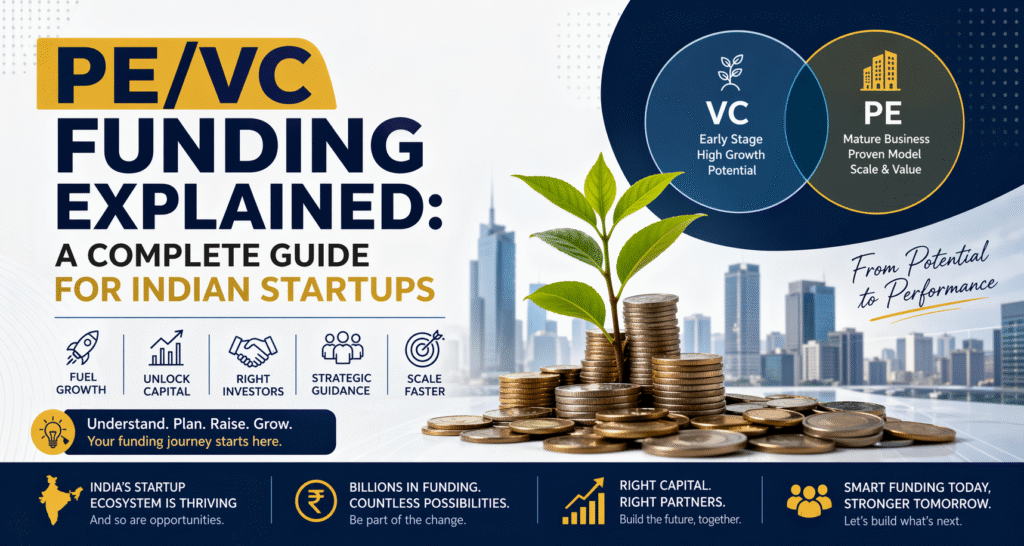
PE (Private Equity) and VC (Venture Capital) funding are two major ways startups in India raise capital to grow.
- Venture Capital (VC): Early-stage funding for startups with high growth potential
- Private Equity (PE): Investment in more mature businesses looking to scale
If you’re building a startup in India, understanding this difference can decide your funding success.
What is PE/VC Funding?
Venture Capital (VC)
Venture capital funding is money invested in early-stage startups that show strong growth potential but may not yet be profitable.
Think: Idea → MVP → Early traction
VC investors bet on your future potential, not just current numbers.
Private Equity (PE)
Private equity funding is typically for established businesses that already have:
- Stable revenue
- Proven business model
- Growth opportunities
Think: Scaling → Expansion → Market dominance
PE investors focus more on financial performance and scalability.
Difference Between PE and VC
| Factor | Venture Capital | Private Equity |
| Stage | Early-stage startups | Mature businesses |
| Risk | High | Moderate |
| Investment Size | Smaller | Large |
| Focus | Growth potential | Profitability & scaling |
| Ownership | Minority stake | Often significant stake |
Why PE/VC Funding is Booming in India
India has become a hotspot for startup funding due to:
- Rising digital adoption
- Large consumer market
- Government initiatives like Startup India
- Increased global investor interest
Sectors like fintech, edtech, SaaS, and D2C brands are seeing massive funding inflows.
How PE/VC Funding Works in India
Step 1: Build a Strong Foundation
Before approaching investors, you need:
- A clear business model
- Defined target market
- Strong founding team
Step 2: Create a Pitch Deck
Your pitch deck should include:
- Problem & solution
- Market opportunity
- Revenue model
- Growth strategy
- Financial projections
Step 3: Approach Investors
You can reach out via:
- Startup networks
- Angel networks
- Incubators & accelerators
Step 4: Due Diligence
Investors will evaluate:
- Financials
- Legal structure
- Market viability
Step 5: Deal & Funding
Once approved:
- Terms are finalized
- Equity is exchanged
- Funds are released
Example (Simple Understanding)
Let’s say you build a fintech app:
- At idea stage → You raise ₹2 crore from VC firms
- After growth → You raise ₹100 crore from PE firms to expand globally
Benefits of PE/VC Funding for Indian Startups
Access to large capital
Mentorship and strategic guidance
Industry connections
Faster scaling opportunities
Common Mistakes Startups Make
Raising funds too early without product-market fit
Overvaluing the company
Ignoring investor alignment
Poor financial planning
Giving away too much equity
When Should You Choose VC vs PE?
- Choose VC funding if:
- You are in early stages
- You need growth capital
- You can handle high risk
- Choose PE funding if:
- Your business is already profitable
- You want to scale aggressively
- You need large capital infusion
FAQs
1. What is the difference between PE and VC funding in India?
VC funds early-stage startups, while PE invests in mature businesses with proven revenue.
2. How can startups get venture capital funding in India?
By building a strong business model, preparing a pitch deck, and connecting with investors through networks or platforms.
3. Is VC funding risky for startups?
Yes, it involves giving up equity and pressure for rapid growth, but it can accelerate success.
4. What are the top sectors attracting VC funding in India?
Fintech, SaaS, e-commerce, edtech, and healthtech.
5. Do startups need profits to get VC funding?
No, VCs focus more on growth potential than current profitability.
Final Thoughts
PE/VC funding is not just about raising money—it’s about choosing the right growth partner.
If you understand when to raise, how much to raise, and from whom, you’re already ahead of 90% of startups in India.
Call to Action
Want help structuring your startup finances or preparing for investor funding? Visit Clover Capital for expert guidance on funding strategy, financial planning, and growth advisory.